
Catholic Life at St. Joseph's
No limits... Just possibilities
Catholic Life
As a Catholic community, the person of Jesus Christ, his life, teachings and his Paschal Mystery, through which we are saved, are at the heart of all we do. Our Mission Statement, ‘Christ in Our Lives, No Limits, Just Possibilities’ embodies what we seek to do at St Joseph’s in nurturing our students and caring for all within our community and beyond.
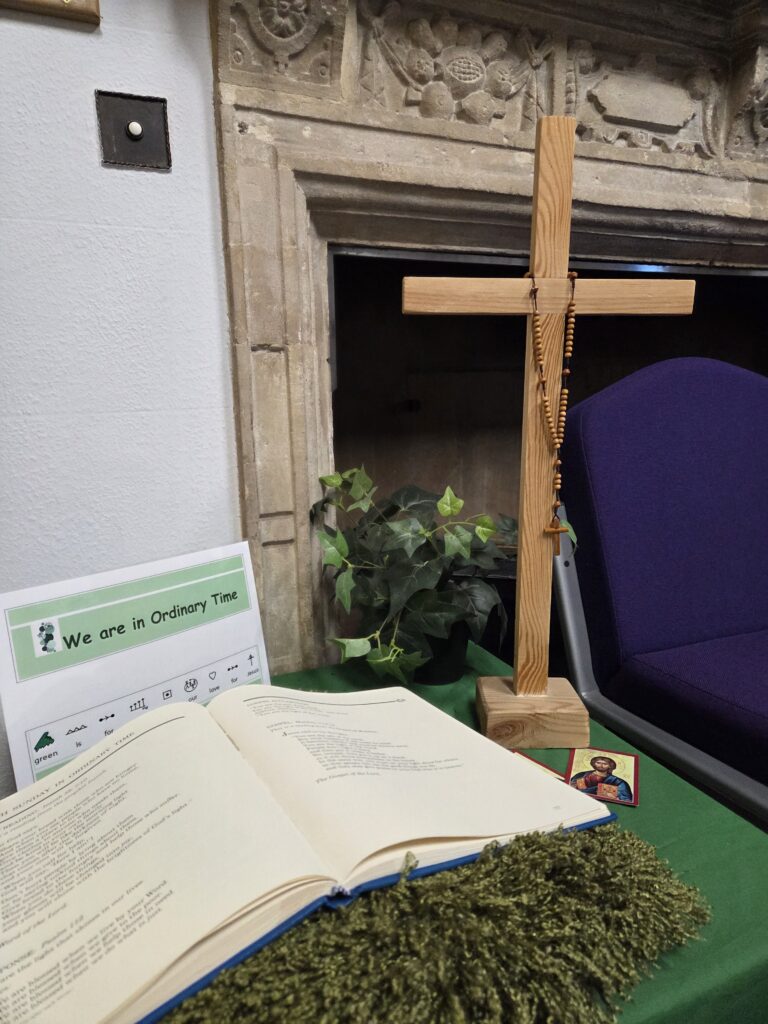
The Religious Education curriculum (To Know you more Clearly) seeks to introduce students to the person of Jesus Christ with the hope that, through learning, they will come to relationship. Within this, we seek to foster appreciation of ‘the other’, of all peoples of all faiths or none. Prayer and Liturgy (To Love you more Dearly) are also at the heart of what we do, introducing and developing the students’ and staff’s experience of prayer and its liturgical expressions within the Catholic Tradition.
Chaplaincy
Catechesis is part of the Church’s mission to evangelise, to proclaim the Gospel of Jesus Christ. It is different to religious education in that the catechist journeys alongside the student, sharing and exploring faith together.
“Proclaiming the Gospel is witnessing to an encounter that keeps the focus on Jesus Christ, the Son of God, incarnate in the history of humanity, in order to bring to fulfilment, the revelation of the Father’s saving love.” (Directory for Catechesis, preface)
We have specially adapted catechetical programmes for those Catholic students whose parents wish them to receive the sacraments. Over the years we have prepared students for the sacraments of Baptism, Confirmation and Holy Communion and Reconciliation.
We believe that all the baptised have an inalienable right to the sacraments which are gifts from God and special encounters with Jesus, bestowing grace and strength on the recipient.
Our abiding principle is that expressed in the Church’s Directory for Catechesis:
“Persons with disabilities are called to the fulness of sacramental life, even in the presence of severe disorders. The sacraments are gifts from God, and the liturgy, even before being rationally understood, needs to be lived: there fore no one can refuse the sacraments to persons with disabilities.” (Directory for Catechesis, 272.)
Any parents(s) wishing their child to receive catechetical formation and reception of the sacraments should contact the Leader of Catholic Life, David Purcell.
Catholic Social Teaching
14 What good is it, my brothers and sisters, if you say you have faith but do not have works? Can faith save you? 15 If a brother or sister is naked and lacks daily food, 16 and one of you says to them, “Go in peace; keep warm and eat your fill,” and yet you do not supply their bodily needs, what is the good of that? 17 So faith by itself, if it has no works, is dead…26 For just as the body without the spirit is dead, so faith without works is also dead.
James 2:14-17, 26
There are nine key principles of Catholic Social Teaching through which we can live out our faith:
Human Dignity, The Common Good, Participation, Stewardship, Solidarity, Subsidiarity, Preferential Option for the Poor, Distributive Justice, Promoting Peace.
Each week, we highlight a specific principle and this is incorporated into prayer and liturgy and classroom discussions.
St Joseph’s offers a considerable range of experiences and opportunities to our students which enable them to engage with these principles. Work experience and Enterprise, for example, promotes the students’ dignity, the dignity of work and taking part. Horticulture enables students to engage with nature and the principle of stewardship over God’s gifts and our common home. Our charitable giving such as Harvest donations to Cranleigh foodbank reflect the principle of preferential option for the poor. Our Student Council gives students a voice and so supports the principle of subsidiarity.
The school was awarded the Oscar Romero Participator Level Award in July 2024 and the Developer Level in March 2025. We are the first school in the Diocese of Arundel and Brighton to achieve this level.
Spiritual, Moral, Social & Cultural Procedures
St Joseph’s Specialist Trust considers the promotion of young people and students’ spiritual, moral, social and cultural development to be a ‘whole school’ issue. This includes but extends beyond religious education to embrace every aspect of the curriculum and the broad range of experiences and opportunities provided for each pupil and student. In terms of spiritual development, we recognise that, whilst many students have cognitive impairments, there is no such thing as a spiritual impairment. We are all spiritual persons. Bishop Comensoli states that “…the profoundly cognitively impaired are in the image of God by nature. There is thus no need to prove that they bear the image of God. It is we the ‘rationally capacious’, who have the capacity to mar the image of God by conscious opposition to God’s grace.” (In God’s Image, Recognising the Profoundly Impaired as Persons, Cascade Books, 2018)


We align with the following UN Sustainable Development Goals:


